


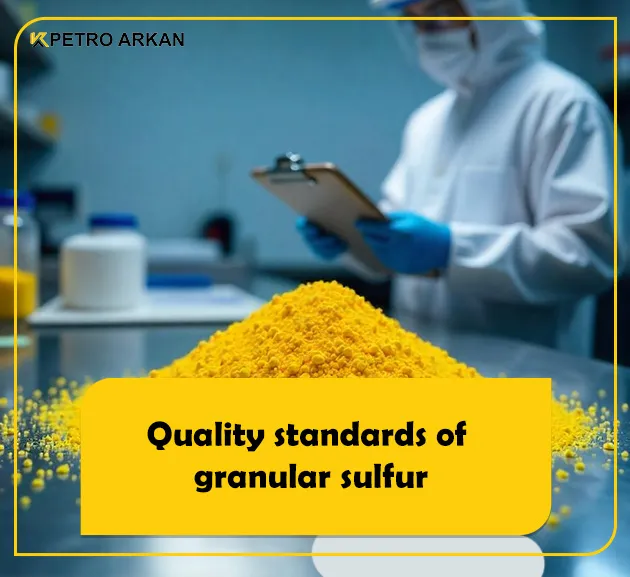
Quality standards of Granular sulfur are key to its effectiveness in agriculture, chemicals, and refining. Strict standards ensure high purity, optimal particle size, and minimal impurities, guaranteeing reliable performance across industries.
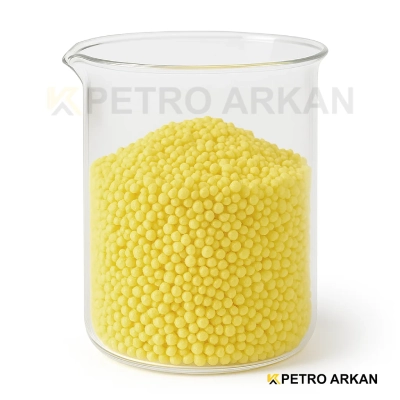


Granular sulfur specifications
Sulfur is a yellow, tasteless, odorless element essential for protein synthesis and acid production. Its unique properties make it vital in daily life and industry.

Granular sulfur is unprocessed sulfur from refineries or mines, found in pure form or combined with other elements. Often called a “lamp” or “chip,” its solid structure resists oxidation, requiring powdering or micronization for agricultural use. It can also be processed from powdered or liquid sulfur while adhering to the quality standards of granular sulfur.
As you know, we have other types of sulfur. If you want to get more information about Pastille sulfur vs. granular sulfur, you can click on it and up-to-date yourself.
Chemical Properties of Granular Sulfur:
| Property | Value |
| Molecular Weight | 32.065 |
| Appearance | Pale yellow granules |
| Melting Point | 112-120 °C |
| Boiling Point | 444.6 °C |
| Density | 1.9-2.1 g/cm³ |
| Solubility in H₂O | Insoluble |
| Vapor Pressure | 1 mmHg (183.8 °C) |
| Vapor Density | 10 mmHg (246 °C) |
| Thermal Conductivity | 0.205 W/cm/K |
| Electrical Resistivity | 0.205 W·m⁻¹·K⁻¹ |
| Electronegativity | 2.58 Paulings |
| Heat of Vaporization | 45 kJ mol⁻¹ |
Technical granular sulfur specifications
| Specification | Value |
| Purity, wt % | Min 99.80 |
| Inorganic Ash, wt % | Max 0.05 |
| Carbon, wt % | Max 0.05 |
| Acidity as H₂SO₄, wt % | Max 0.003 |
| Moisture | Max 0.1 |
| Particle Size | 0.5 mm to 4 mm (Granular) / Up to 200 Mesh (Powder) |
| Packaging | 25kg, 50kg, 1000kg Bags or Bulk |
Granular sulfur grading criteria
Granular sulfur plays a crucial role in a wide range of industries, including agriculture, chemical manufacturing, and pest control. Its versatility makes it an essential component in processes like soil enrichment, fertilizer production, and the synthesis of sulfuric acid.
For it to perform optimally and meet industry standards, quality standards of granular sulfur must meet specific grading criteria that guarantee its effectiveness, safety, and environmental compatibility.
These criteria ensure that the sulfur maintains its high quality throughout its life cycle, from production to use in various applications. These criteria are:
Purity
One of the standards for granular sulfur quality is purity. A minimum sulfur content of 99.5% ensures the product’s efficacy and consistency across different industries, from agriculture to chemical manufacturing.
High purity prevents contamination, ensuring the product works as intended in applications like soil fertilization and sulfuric acid production.
Particle Size Distribution
Granules ranging from 2 to 6 mm in diameter, with at least 90% of particles falling within this range, are essential for ease of application and efficiency. This is the second criterion of quality standards of granular sulfur. The uniform size ensures the sulfur is evenly distributed in agricultural soil, facilitating better absorption and effectiveness.
Moisture Content
Moisture should be kept below 0.5% to prevent clumping and caking, which can affect storage and ease of use. Maintaining low moisture levels ensures that sulfur remains stable during transport and is easy to handle when applied in various industrial processes.
Ash Content
Limiting ash content to 0.05% ensures that the sulfur remains free of impurities, allowing for consistent performance. High ash content can interfere with the quality standards of granular sulfur’s effectiveness, so this standard helps maintain its integrity during use in applications that require high purity.
Acidity (as H₂SO₄)
Acidity levels are kept to a maximum of 0.02% to prevent corrosive effects on equipment, storage containers, and the environment. This ensures that granular sulfur can be handled safely without causing damage to infrastructure or posing risks during use.
Color and Odor
One of the quality standards of granular sulfur is color. Bright yellow granules and an odorless nature are indicative of the sulfur’s purity. Any deviations in color or odor can suggest contamination, which may compromise its quality and application. This visual and sensory cue helps ensure the product meets industry standards.
Elemental Composition
Granular sulfur must contain minimal traces of heavy metals like iron, copper, zinc, arsenic, lead, and mercury. Excessive levels can harm the environment and compromise safety in agricultural and industrial applications. Keeping these metals low ensures sulfur remains safe, reliable, and eco-friendly.
Quality control for granular sulfur
To ensure the safety, compliance, and quality standards of granular sulfur, they must meet strict certification standards. Certification also supports global trade by verifying quality control, regulatory adherence, and environmental standards. The following certifications and quality measures are essential for maintaining industry standards. These granular sulfur certification requirements are:
- ISO 9001: Ensures consistent production quality standards of granular sulfur under an ISO 9001:2015 certified system.
- ASTM Compliance: Standardized tests like ASTM D2622 verify sulfur content and purity.
- Product Certification: A Certificate of Analysis (CoA) confirms key specifications.
- Third-Party Inspection: Independent verification through sampling, testing, and certification.
Many of the clients are confused and can’t decide whether to buy lump or this kind of sulfur. You can visit this page on lump sulfur vs. granular sulfur to decide better.
What are the key factors of high quality granular sulfur fertilizer?
Quality standards of Granular sulfur, which is represented by the letter S, are a chemical element found in the sixth group and the third row of the periodic table. The method of making sulfur granules involves creating meltable materials in special drums.
The things that affect the Quality standards of Granular sulfur are:
- Improving the soil’s texture.
- Give plants everything they need to grow.
- More plant growth and higher product output.
- Test the soil and plants for nutrients once a year to lower fertilizer costs.
- No need to use the same kind of fertilizer.
- Make farming and garden watering use less time and resources.
- Bioorganic means things that are made from natural materials and are good for the environment.
- No need for harmful chemicals in plants.
These factors can depend on the sulphur granular specification, as the properties of this element are so important, and you should know any points about it. Understanding of granular sulphur specifications can improve the growth of your plant.
Is granular sulfur necessary for the growth of plants?
In plants, a lack of sulfur shows up as pale yellow leaves and yellowing in the young parts of the plant. Not having enough sulfur can seriously affect how plants grow. The stems become weak, and the leaves curl up.
When plants don’t have enough sulfur, they build up a type of nitrogen that is not good for making proteins. Eating these plants can be harmful to animals that chew their food, like cows and sheep.
When plants don’t have enough Quality standards of Granular sulfur, they end up with too much nitrate, which can be harmful to animals that eat them. Sulfur is very important for plants to grow, even more so than phosphorus.
What is the packing for the granular sulfur fertilizer factory?
For sure, the most important question that maybe you are curious about is what is the best way to pack the Quality standards of Granular sulfur? In this part, we will give you some suggestions that you can consider based on your plants.
Granulated sulfur is not included in the rules of ADR, RID, IMO, IMDG Code, and IATA under Special Provision No. 242 says that sulfur doesn’t have to follow these rules if it is made into certain shapes (like). It will keep in Small round pieces, small grainy bits, little balls, flat disks, or thin pieces.
Why purchase at Petroarkan?
Petroarkan is a dependable supplier of high-quality granular sulfur fertilizers at competitive prices. With a strong focus on reliability and excellence, the company ensures cost-effective solutions that meet agricultural needs while maintaining strict quality standards of granular sulfur.
As an essential nutrient for soil health and crop growth, sulfur plays a key role in farming, but sourcing the right fertilizer can be challenging. Petroarkan simplifies this by offering premium granular sulfur, making it the top choice for those prioritizing quality and value.
Summary
Granular sulfur is crucial in agriculture and industry, requiring strict quality standards like 99.80% purity, low moisture, and specific particle sizes. It must have minimal ash, acidity, and heavy metals. Quality control includes certifications like ISO 9001 and third-party inspections to ensure safety and effectiveness. Granular sulfur is essential for soil enrichment, fertilizer production, and sulfuric acid synthesis.
FAQ
- What acidity level is allowed in granular sulfur?
Acidity (H₂SO₄) must stay below 0.003% to prevent corrosion.
- What heavy metals should be avoided in granular sulfur?
Heavy metals like iron, copper, zinc, arsenic, lead, and mercury.
- What happens if granular sulfur has excessive moisture content?
Excess moisture can cause clumping, reducing effectiveness and ease of use.


No comment